

Report on human rights violations in Ahwaz Region
By Alahwazi Organization for Human Rights
The Legal Framework
The International Covenant on Civil and Political Rights (ICCPR), ratified by Iran in 1975, includes numerous provisions related to minority rights, including the right to use their own language under Article 27. [1] Following the 1979 revolution, Article 15 of the Iranian Constitution permitted the use of regional and tribal languages in education and media alongside Persian, theoretically recognising the right of non-Persians to education in their mother tongue and to equal opportunities. However, in practice, Iranian policies have systematically deprived individuals and communities, particularly Ahwazi Arabs, of these rights guaranteed by the ICCPR and the Constitution, through restrictions on Arabic-language education, employment opportunities, and socioeconomic development. [2]
Article 2 of the International Covenant on Civil and Political Rights requires all states to ensure the rights recognised in the Covenant without discrimination of any kind. [3] This fundamental principle of non-discrimination is also enshrined in Article 2(2) of the International Covenant on Economic, Social and Cultural Rights (ICESCR), which Iran ratified in 1975. Iran is thus bound by its treaties to provide a full range of rights to its citizens without discrimination based on race, colour, sex, language, religion, political opinion, national or social origin, property, or other status. These rights include equality before the law, as well as equal access to education, healthcare, employment opportunities, housing, and social security. However, in practice, Iran has implemented policies that are in stark contrast to the laws of the Covenant, deliberately depriving Ahwazi Arabs of their rights.
Ahwazi (Arabs) are a recognised ethnic group in Iran under Article 15 of the 1979 Constitution, which guarantees their freedom to practice religious, cultural, and ethnic rituals and to follow their own rules in matters of personal status and religious and ethnic education. However, Iranian authorities have restricted these rights, citing national security concerns, by perceiving Ahwazi Arabs as a threat to the regime. This results in a systematic violation of their cultural, linguistic, and other rights protected under the International Covenant on Civil and Political Rights (ICCPR) and the Constitution. [4]
The human rights situation in Ahwaz under Iranian authorities has raised significant concerns among leading international human rights organisations. Reports of persistent and deliberate violations have emerged since the 1979 revolution, with abuses intensifying significantly after the 2005 Ahwazi uprising. International reports, including those by the UN Special Rapporteur and Amnesty International, have documented “widespread and systematic” torture, harassment, arrests, assaults, and executions targeting human rights defenders, cultural and political activists, peaceful protesters demanding economic rights, and farmers opposing land confiscation policies. Amid increasingly discriminatory policies driven by internal conflicts and external pressures, the UN and human rights experts note bleak prospects for reform. [5] This ongoing approach constitutes a deliberate violation of Ahwazi citizens’ rights under the International Covenant on Civil and Political Rights (ICCPR) and the International Covenant on Economic, Social and Cultural Rights (ICESCR), prompting urgent calls for sustained international scrutiny.
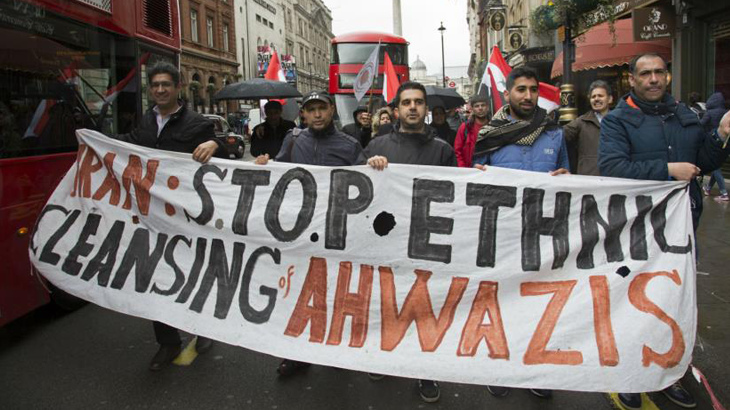
Reports issued by international organisations, the European Union, the United States, and Canada have consistently condemned Iran’s human rights record, particularly in Ahwaz. According to a 2019 US State Department report and Amnesty International, Iranian security forces and the Revolutionary Guards killed at least 130–150 Ahwazi Arabs in Jarahi (Mahshahr/Ma’shour) during November 2019 protests, targeting civilians to suppress dissent. [6] These forces also arbitrarily arrested dozens of individuals, subjecting them to torture, extrajudicial killings, and unfair trials without access to legal representation, in violation of the International Covenant on Civil and Political Rights (ICCPR). In response, the United States and several European countries have imposed sanctions on Iranian officials for these and other gross human rights violations. [7]
Specific violations under the two international covenants
Arbitrary Arrest and Detention
Iranian authorities continue to target Ahwazi Arabs through arbitrary arrests and detention without clear charges or due process, aiming to suppress cultural identity, political dissent, and protests against economic and environmental marginalisation. Authorities often justify these arrests by labelling Ahwazi Arabs as separatists or national security threats, [8] violating Article 9 of the International Covenant on Civil and Political Rights (ICCPR), which prohibits arbitrary detention and guarantees a fair trial, and the Convention against Torture. For example, in July 2025, the Ahwazi Karon Human Rights Organisation reported that activists Ali Mojdam, Moin Khanfari, and Mohammad Reza Moghadam faced imminent execution on “rebellion” charges, based on forced confessions obtained under torture and without fair trials. [9] Similarly, in 2015, Ahmad Hazbawi was arrested for singing an Arabic song at a wedding, and in 2018, over 600 Ahwazi Arabs, including pregnant activist Sahba Hammadi, were detained without legal basis following protests. The 2019 Ma’shour protests saw mass arrests, with detainees like Benyamin Alboghbish subjected to torture and extrajudicial killing, highlighting a pattern of incommunicado detention and intimidation to silence Ahwazi Arabs, as documented by Amnesty International and the UN Special Rapporteur. [10]
Capital punishment
Iranian authorities employ the death penalty to suppress political and cultural activism among Ahwazi Arabs, targeting their ethnic identity and dissent. According to the Ahwaz Human Rights Organisations and Human Rights Watch, dozens of Ahwazi activists have died under torture or face execution on vague charges such as “Moharebeh” (enmity against God) or “corruption on earth,” often following unfair trials that violate Article 14 of the International Covenant on Civil and Political Rights (ICCPR), which guarantees a fair and public trial. These executions are designed to silence dissent and intimidate the Ahwazi Arab people, as documented by Amnesty International and the UN Special Rapporteur. The use of capital punishment in Ahwaz has escalated as a mechanism to deter Ahwazi Arab activism, particularly following major protests and uprisings, with executions often carried out after secret trials and coerced confessions.
Women’s Rights
Ahwazi women suffer double discrimination due to their Arab ethnicity and gender. They are particularly targeted when participating in protests or cultural activities, facing harassment and arbitrary arrests. They are also denied equal access to higher education and employment opportunities, in violation of Article 3 of the International Covenant on Economic, Social and Cultural Rights, which guarantees gender equality. Furthermore, Ahwazi women endure gender-based violence, including sexual assault, in detention centres, as documented by Ahwazi human rights organisations and Amnesty International. [11]
According to a 2023 report by Dialogue Institute for Research and Studies, approximately 65% of Ahwazi women lack access to secondary or higher education due to discriminatory policies that prioritise Persian-language instruction and limit school infrastructure in Arab-majority areas. This educational exclusion contributes to high unemployment rates, with over 70% of Ahwazi women economically inactive, often confined to low-wage or informal labour due to systemic barriers in accessing skilled employment in Ahwaz oil industry. Additionally, women participating in protests, such as the 2018 water shortage demonstrations, face targeted arrests and sexual violence in detention, as seen in the case of Sahba Hammadi, a pregnant activist detained without charge. These violations, documented by Amnesty International and Human Rights Watch, reflect a deliberate strategy to suppress Ahwazi women’s activism and perpetuate their socioeconomic exclusion.
Religious Rights
Despite Iran’s constitutional acknowledgment of ethnic diversity, Ahwazi Sunni Muslims and Mandaeans face systematic repression of their religious practices, violating Article 18 of the International Covenant on Civil and Political Rights (ICCPR), which guarantees freedom of religion or belief. Iranian authorities prohibit collective Sunni prayers and the construction of Sunni mosques in major cities in Ahwaz region, while Mandaeans, an unrecognised religious minority, are banned from performing public rituals like river baptisms, with their community centres confiscated or destroyed, forcing many to emigrate. [12]
Religious activists face arbitrary arrests and harassment, such as the 2014 detention of 16 Sunni converts during a Qur’an class in Ahwaz, charged with “causing corruption on earth,” and ten others for preaching or holding Taraweeh prayers, with two facing executions. [13] Similarly, in 2019, Mandaean activists were arrested for distributing religious texts, held incommunicado, and tortured, as reported by the Ahwazi Human Rights Organisation. These measures, alongside the destruction of Sunni prayer rooms, aim to erase minority religious identities, exacerbating the social and economic exclusion of Ahwazi Arabs, with 90% in rural areas living in poverty, as documented by Amnesty International, Human Rights Watch, and the UN Special Rapporteur on Iran. [14]
Economy and Housing Rights in Ahwaz
Despite the Ahwaz region’s wealth as Iran’s primary oil-producing area, contributing 85% of the country’s oil revenue, Ahwazi Arabs face severe poverty and systemic economic exclusion, with 90% of rural Ahwazi households living below the poverty line, according to the Minority Rights Group. [15] Discriminatory policies systematically exclude Ahwazi Arabs from employment in the oil, gas, and petrochemical industries, where less than 20% of senior positions are held by Arabs, [16] and unemployment rates in among Ahwazis range from 31% to 50%.
Land confiscation for government projects, such as oil infrastructure and the Gotwand Dam, has displaced thousands of Ahwazi farmers, often without compensation or alternative housing, leading to widespread homelessness. In 2005, UN Special Rapporteur on adequate housing Miloon Kothari reported that Ahwazi Arabs face forced evictions and destruction of homes without legal recourse, violating Article 11 of the ICESCR, which guarantees the right to adequate housing, including security of tenure and access to services. These practices, coupled with the lack of affordable housing and basic services like clean water in Ahwazi communities, exacerbate homelessness, with an estimated 400,000 Ahwazi living in informal settlements or on the streets of Ahwaz city (nearly 1.8 million in all Ahwaz region), as documented by Iranian official sources.
Adequate Standard of Living
Despite the Ahwaz region’s abundance of water sources, including Karon, Karkheh, Jarahi and Dez rivers, which historically supported Ahwaz’s agriculture, Ahwazi Arabs endure substandard living conditions marked by severe water shortages, lack of clean water, and inadequate electricity infrastructure. Discriminatory river diversion projects, such as the Gotwand Dam and the transfer of Karon River water to central Iran, have reduced water availability in Ahwaz region since the 2000s, devastating agricultural lands that once produced 40% of Iran’s wheat and sugar cane. These policies have rendered thousands of hectares of fertile farmland in areas like Susa and Howeyzeh unusable, displacing thousands of farmers and threatening food security for large number of rural Ahwazi households.
The resulting water scarcity, compounded by pollution from oil industries, has left 200 areas in Ahwaz without potable water, forcing reliance on contaminated sources. [17] These conditions violate Article 11 of the International Covenant on Economic, Social and Cultural Rights (ICESCR), which guarantees the right to an adequate standard of living, including access to water, food, and housing, as documented by international organisations on the right to water and sanitation.
Health
Despite the Ahwaz region’s wealth as Iran’s primary oil-producing area, Ahwazi Arabs face severe health challenges due to inadequate healthcare infrastructure and environmental pollution from the oil industry, violating Article 12 of the International Covenant on Economic, Social and Cultural Rights (ICESCR), which guarantees the right to the highest attainable standard of physical and mental health, including access to medical care and healthy environmental conditions.
The region’s limited hospitals contribute to high mortality rates from untreated chronic diseases, such as diabetes and cardiovascular conditions. Oil industry pollution, particularly fine particulate matter (PM2.5), sulphur dioxide (SO2), and volatile organic compounds (VOCs) like benzene, has led to a sharp rise in health issues, including a 500% increase in leukaemia, liver, and skin cancers. Respiratory diseases, such as asthma and chronic obstructive pulmonary disease (COPD), affect large number of Ahwazi residents annually, with hospital admissions for asthma and bronchitis rising significantly due to PM2.5 and nitrogen dioxide (NO2) exposure.
Skin disorders, including dermatitis and allergies, are prevalent due to oil-related chemical exposure, while dust storms, exacerbated by oil industry environmental degradation, increase respiratory infections like pneumonia. These conditions, compounded by water pollution from oil runoff, have caused birth defects and neurological issues, driven premature mortality and reduced life expectancy.
Education
Ahwazis are denied education in the Arabic language, in violation of Article 13 of the International Covenant on Economic, Social and Cultural Rights. These restrictions lead to high school dropout rates and lower educational levels among Ahwazis, hindering their opportunities for personal and professional development. Teachers who attempt to teach Arabic or Ahwazi culture are also harassed.
In Ahwaz region, efforts to establish private Arabic-language schools or cultural centres have been met with repression. According to Iran Wire report, fine Ahwazi cultural activists were arrested for distributing Arabic-language books or teaching Arabic outside the official curriculum, citing “threats to national security.” This indicates that, despite constitutional provisions, no practical ratification or enforcement of mother-tongue education rights has been effectively implemented since 1979.
Cultural Life
Ahwazis face severe restrictions on their cultural activities, such as traditional celebrations or the use of Arabic in public. Cultural activists are arrested, and their books and cultural materials confiscated, violating Article 15 of the International Covenant on Economic, Social and Cultural Rights, which guarantees the right to take part in cultural life.
The public use and teaching of Arabic, the native language of Ahwazi Arabs, are heavily restricted, with Persian mandated as the sole language of instruction in schools, and Arabic cultural events, such as poetry readings at the Al-Hiwar Cultural Institute, banned or raided. Cultural activists face arbitrary arrests, as seen in the 2019 detention of Hassan Sari from the Nasr Cultural Institute for producing an Arabic-language video, promoting Ahwazi identity, as reported by the Ahwazi Centre for Human Rights. [18]
Since 2005, over 1,200 Ahwazi cultural and political activists have been arrested, with many, including Hadi Rashedi and Hashem Shabani of the Al-Hiwar Cultural Institute, executed following unfair trials, according to Human Rights Watch. [19] Authorities have confiscated Arabic books, poetry collections and cultural artifacts. These policies, aimed at Persianizing the region, erode the Ahwazi Arab identity, exacerbating socioeconomic marginalisation in a region that produces 85% of Iran’s oil revenue, as documented by UNPO and the UN Special Rapporteur on cultural rights.
Conclusion
The systematic human rights violations against Ahwazi Arabs represent a grave breach of Iran’s obligations under the International Covenant on Civil and Political Rights (ICCPR) and the International Covenant on Economic, Social and Cultural Rights (ICESCR), necessitating urgent international action to ensure accountability and uphold the fundamental rights of this marginalised people. The Iranian authorities’ ongoing practices—arbitrary arrests and executions of activists like Ali Mojdam, Moin Khanfari, and Mohammad Reza Moghadam on vague charges such as “rebellion” (violating ICCPR Article 9), systematic suppression of Arabic cultural activities and language use (violating ICESCR Article 15), and persecution of Sunni Muslims and Mandaeans (violating ICCPR Article 18)—aim to erase Ahwazi Arab identity.
Compounded by severe health disparities, with 500% rise in cancers due to oil industry pollution (violating ICESCR Article 12), and economic exclusion, with 90% of rural households in poverty and unemployment rates of 31–50% (violating ICESCR Article 11), these policies have devastated Ahwazi people. Forced evictions and home demolitions, as reported by UN Special Rapporteur Miloon Kothari in 2005, violate the right to adequate housing (ICESCR Article 11), with an estimated 1.8 million Ahwazi Arabs living in informal settlements (400,000 in Ahwaz city). The international community, including the UN Human Rights Council, must urgently deploy independent investigations, impose targeted sanctions on responsible officials, and establish monitoring mechanisms to address these violations, protect Ahwazi rights to cultural expression, health, housing, and an adequate standard of living, and set a precedent for accountability in Iran’s treatment of ethnic minorities, as documented by international organisations.
References
[1] United Nations, International Covenant on Civil and Political Rights, UN General Assembly Resolution 2200A (XXI), 16 December 1966, available at https://www.ohchr.org/en/development/international-standards.
[2] Dialogue Institute for Research and Studies, Ahwazi Children Face Discrimination in Iran’s Education System, 23 November 2023, available at https://astudies.org/2023/11/denied-opportunities-ahwazi-children-face-discrimination-in-irans-education-system/.
[3] United Nations, International Covenant on Civil and Political Rights, UN General Assembly Resolution 2200A (XXI), 16 December 1966, available at https://www.ohchr.org/en/development/international-standards.
[4] Amnesty International, Human Rights in Iran 2025, April 2025, available at https://www.amnesty.org/en/documents/mde13/9275/2025/en/.
[5] UN Special Rapporteur on Iran, Report on the Situation of Human Rights in the Islamic Republic of Iran, A/HRC/58/62, Advance edited version, March 2025, available at https://www.ohchr.org/en/documents/country-reports/ahrc5862-situation-human-rights-islamic-republic-iran-report-special.
[6] US Department of State, 2019 Country Reports on Human Rights Practices: Iran, March 2020, available at https://www.state.gov/reports/2019-country-reports-on-human-rights-practices/iran/.
[7] Council of the European Union, Iran: Council Adopts Conclusions and Sanctions for Human Rights Violations, 12 April 2021, available at https://www.consilium.europa.eu/en/press/press-releases/2021/04/12/iran-council-adopts-conclusions-and-sanctions-for-human-rights-violations/.
[8] Iran Human Rights Documentation Centre, A Framework of Violence: Repression of the Arab Ethnic Minority in the Islamic Republic of Iran, 18 March 2015, available at https://iranhrdc.org/a-framework-of-violence-repression-of-the-arab-ethnic-minority-in-the-islamic-republic-of-iran/.
[9] Karoon Human Rights Organisation, Phone Call of Three Arab Prisoners Sentenced to Death, 14 July 2025, available at https://khro.org/تماس-تلفنی-سه-زندانی-عرب-محکوم-به-اعدام/.
[10] UN Special Rapporteur on Iran, Situation of Human Rights in the Islamic Republic of Iran, A/HRC/43/61, January 2020, available at https://docs.un.org/en/A/HRC/43/61.
[11] Amnesty International, Human Rights in Iran 2025, April 2025, available at https://www.amnesty.org/en/documents/mde13/9275/2025/en/.
[12] Iran Wire, Ancient Roots, Modern Struggles: The Mandaeans’ Fight for Survival in Iran, 4 October 2024, available at https://iranwire.com/en/religious-minorities/132571-ancient-roots-modern-struggles-the-mandaeans-fight-for-survival-in-iran/.
[13] Peter Tatchell Foundation, Iran Escalates the Persecution of Sunni Muslims, 22 January 2015, available at https://www.petertatchellfoundation.org/iran-escalates-the-persecution-of-sunni-muslims/.
[14] Minority Rights Group, Arabs in Iran, 16 October 2023, available at https://minorityrights.org/minorities/arabs/.
[15] Minority Rights Group, Arabs in Iran, 16 October 2023, available at https://minorityrights.org/minorities/arabs/.
[16] UNPO, Ahwazi: Country’s Highest Poverty Rate For Arab Ahwazi, 2018, available at https://unpo.org/ahwazi-country%EF%BF%BDs-highest-poverty-rate-for-arab-ahwazi/.
[17] Dialogue Institute for Research and Studies, Ahwazis Endure Water Shortages and Power Cuts at Iranian Regime’s Hands as Temperatures Rise to 50C, July 2023, available at https://astudies.org/2023/07/ahwazis-endure-water-shortages-and-power-cuts-at-iranian-regimes-hands-as-temperatures-rise-to-50c/.
[18] Ahwazi Centre for Human Rights, Mass Arrests Against Ahwazi Activists in Fear of Deteriorating Situation During Iranian New Year, 21 March 2019, available at https://acfh.info/en/?p=3080.
[19] Human Rights Watch, Iran: Sweeping Arrests of Ahwazi Arab Activists, 29 April 2015, available at https://www.hrw.org/news/2015/04/29/iran-sweeping-arrests-ahwazi-arab-activists.
